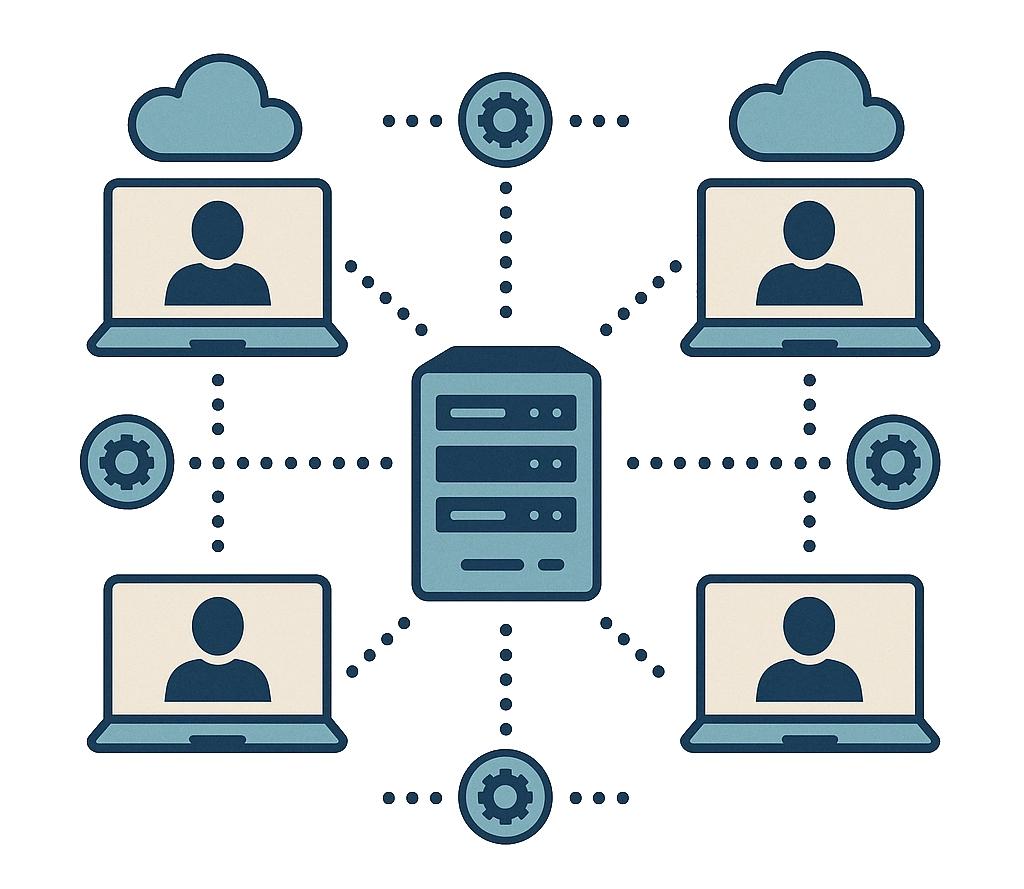
Why Does Your Business Need Federated Learning
Keep Your Data Safe
Train powerful AI models collaboratively, without ever sharing your sensitive data.
Build Smarter AI
Access the collective intelligence of multiple organisations while maintaining complete data privacy.
Stay Compliant & Competitive
Meet strict regulations like GDPR and HIPAA while still leveraging AI to grow your business.
How Federated Learning Works
A Simple 4-Step Process
- A basic AI model template is sent to your organisation:
No data leaves your systems, only the model weights. - The model learns from your data locally on your own servers:
Your sensitive information never leaves your control. - Your system sends back only the learned patterns:
Not your actual data to improve the shared model. - Receive an enhanced AI model:
All while keeping your data completely private.
Interactive Demonstration
See the real business impact - compare working alone vs. collaborating privately
Industry Scenario
Predictive Maintenance
Collaborative machine failure prediction across factories without sharing proprietary production data.
Why This Matters
Individual factories often lack enough failure data to build accurate models. Federated learning allows them to pool insights while keeping operational data private.Dataset
- AI4I 2020 Predictive Maintenance Dataset: UCI Repository
- Synthetic industrial sensor data: 10,000 machine observations
Key Data Features
- Temperature
- Speed
- Torque
- Tool Wear
- Failure Types
Privacy Protection
- Production metrics stay confidential
- Only anonymized model updates shared
- Complies with trade secret protection requirements
Simulation parameters
Adjust the settings below to see how different scenarios affect model performance.
Evaluation data - measures real-world performance
Training data - what the model learns from
Number of organizations participating. More participants improve model quality but increase coordination complexity.
Number of collaboration cycles. Each round requires network communication from all participants.
Controls training speed. Higher values train faster but may be unstable.
- 0.5
- 3
Model Performance: Traditional vs Federated Learning
Prediction error (lower = better)
Percentage of correct predictions (higher = better)
Accuracy of positive predictions (higher = better)
Ability to find all positive cases (higher = better)
Balance between precision and recall (higher = better)
Limitations & Considerations
Even though Federated Learning offers major advantages in privacy and collaboration, it also comes with its own technical and operational realities. Explore the tabs below to understand the key considerations, challenges, and resource requirements that impact real-world deployment.
Implementation Considerations
Each participating organization trains the model locally, meaning the computation happens on their own infrastructure — not on a central server. This approach preserves data privacy but demands adequate computational resources and network bandwidth, especially since model updates can range from a few megabytes to several gigabytes per round.
Security Considerations
While raw data never leaves participant systems, the model updates exchanged during training may still reveal subtle patterns. For that reason, a trusted aggregation server and secure communication protocols are essential. It’s also important to guard against poisoning attacks, where compromised participants could influence the shared model.
Operational Considerations
Federated training generally takes 2–5 times longer than centralized approaches due to distributed coordination. Each round requires synchronization between all participants, so if any drop out or lose connectivity, overall progress may slow down. For the best results, at least 3–5 participants should remain consistently engaged.
About us
User Centered Experiences (UCE)
UCE is a research group that focuses on the development of practical and sustainable digital solutions where the end user is central. Affiliated with the Electronics-ICT program, we focus our research on three core areas: User Experience (UX), Data & AI and innovative mobile applications.
In our research vision, Data & AI and UX are no longer separate. We specifically explore the synergy between these domains: how UX principles can make AI systems more transparent and accessible, and how Data & AI can in turn enrich and personalise the user experience Thus, we make complex AI predictions insightful for users and explore how AI can be responsibly deployed to optimise user experiences.
Our hands-on research results in tangible proof-of-concepts that translate technical innovation into accessible and sustainable solutions. To this end, we work closely with other research groups and partners in the field. Our research creates impact in various sectors, including healthcare and services.

Our Focus
Within UCE, we bundle our expertise around three research pillars
User Centered Research
We explore how digital experiences can best meet the needs of end users through co-creation and user testing.
Data & AI
We explore the responsible use of AI for personalised user experiences as well as how to make AI itself more accessible.
Innovative web & mobile applications
We develop applications that translate technological innovation into practical, user-friendly solutions.
Get In Touch
We'd love to discuss how federated learning can benefit your specific situation. Whether you have questions about implementation, want to explore collaboration opportunities, or need guidance on getting started, we're here to help with practical, business-focused advice.